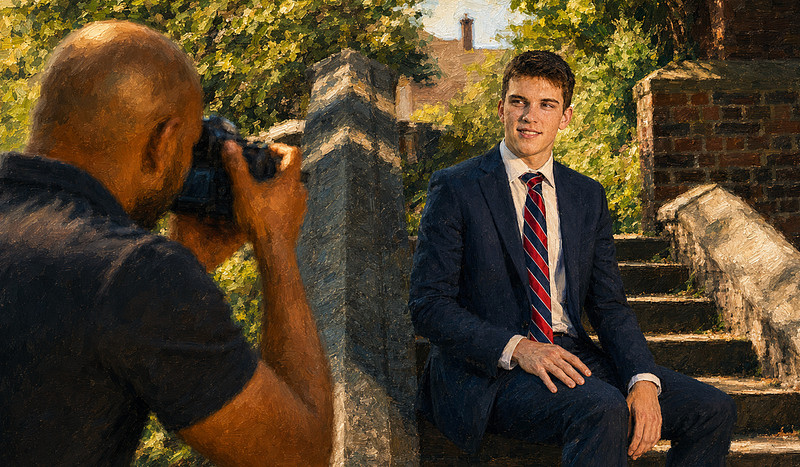

There are parts of every senior photo session that should stay consistent.
The lighting should be intentional. The photographs should be technically sound. Clothing should be checked. Backgrounds should be chosen carefully. The senior should receive clear direction instead of being expected to know what to do in front of a camera.
What should not stay exactly the same is the person being photographed.
One high school senior may arrive talking before I have even taken the camera out. Another may need a little time before they become comfortable. Someone may naturally move well and look better walking, leaning, or shifting between positions. Another senior may look strongest when everything becomes quieter and the photograph is built around a simple expression.
That is why I do not think every high school senior photo session should follow the same formula.
If people do not behave exactly the same way, there is not much reason to photograph all of them exactly the same way.
Good Photography Can Be Consistent Without Every Session Looking Identical
Consistency matters.
When families hire a senior photographer, they should be able to look through the portfolio and have a reasonable understanding of the quality they can expect. Exposure, composition, color, focus, editing, and attention to detail should not change dramatically depending on who happens to be standing in front of the camera.
But consistency in quality is different from repetition.
If every senior stands against the same wall, crosses their arms the same way, gives the same expression, and moves through the same sequence of poses, the photographer may be producing technically consistent work while ignoring the differences between the people being photographed.
A senior photo session can have structure without becoming a template.
The photographer can know what types of photographs need to be created while still deciding how to get there based on the person in front of the camera.
I Pay Attention Before I Decide How Much Direction Someone Needs
Some seniors want a lot of direction.
They want to know where their feet should go, what to do with their hands, where to look, and whether their posture looks right.
There is nothing wrong with that.
Most high school seniors are not professional models, and they should not be expected to arrive knowing how to position themselves for a photograph.
Other seniors need much less instruction.
You may give them a starting position and discover that the best photographs happen in the few seconds afterward when they adjust naturally.
The photographer has to recognize the difference.
Giving constant instructions to someone who already moves comfortably can make them stiff. Giving almost no direction to someone who is nervous can leave them wondering whether they are doing anything correctly.
Neither approach works for everybody.
During a high school senior photo session, I am paying attention to how the senior responds. If something works, I can build from it. If a pose technically looks fine but clearly does not suit the person, there is little reason to keep forcing it.
Some Seniors Look Better Moving
There are people who become uncomfortable the second they are asked to stand perfectly still.
Give them something to do and the entire photograph changes.
Walking toward the camera can create better posture than repeatedly telling someone to straighten up. Turning while moving can produce a better expression than asking for one. Adjusting a jacket, stepping off a curb, walking along a railing, or changing direction can give the hands and body something natural to do.
Movement can also help someone stop thinking about every small part of their body.
That does not mean every photograph needs motion.
The movement may simply be what gets us into the next photograph.
A senior might walk several steps, stop, look toward me, and suddenly the still portrait works because we did not begin by placing every part of their body into position.
For athletic seniors especially, movement may feel considerably more natural than holding a pose for an extended period.
But even then, I do not assume that every athlete needs an action-oriented session. Being involved in sports tells me something about the senior. It does not tell me everything about how they should be photographed.
Other Seniors Are Strongest When the Photograph Gets Quieter
Not everybody needs to laugh.
That sounds obvious, but senior photography can sometimes become overly focused on producing the largest possible smile.
Some people have a naturally calm expression that photographs extremely well. They may look comfortable leaning against a wall, sitting on a set of steps, or simply looking toward the camera without being asked to perform an emotion.
That expression should have room in the gallery.
Parents may understandably want a smiling portrait, and I think it is important to create one when possible. But a complete senior gallery does not need 30 versions of the same smile.
A serious portrait can be strong.
So can a small smile.
So can a photograph where the senior is looking somewhere other than the camera.
The expression should make sense with the person, the clothing, the environment, and the type of photograph being created.
An Editorial Approach Works Better for Some Seniors Than Others
Some seniors immediately respond to photographs that feel a little more deliberate.
They may be interested in fashion, photography, modeling, music, design, or simply like imagery that feels different from a traditional school portrait.
That gives me room to push the session in a more editorial direction.
The lighting might become stronger. The composition may be less conventional. Architecture can become a bigger part of the frame. The pose may become more deliberate. I may create photographs with more negative space, stronger shadows, or an angle that would not normally appear in a traditional senior portrait.
That does not mean the entire gallery needs to look like a magazine editorial.
A senior can have a clean portrait for family members and graduation announcements alongside photographs that are considerably more stylized.
The balance can change from one person to another.
Someone who loves that type of photography may want to spend more time creating it. Someone else may prefer simpler portraits and feel uncomfortable with heavily directed editorial posing.
The session should be able to accommodate both.
Personal Interests Can Influence the Session Without Taking It Over
Learning that a senior plays basketball, paints, works on cars, dances, performs in the school band, or spends most of their free time gaming can help me understand the person I am photographing.
Sometimes that interest belongs directly in the photographs.
Sometimes it does not.
A basketball may make sense in several portraits for a student who has spent years playing the sport. That does not mean the basketball needs to appear in the entire gallery.
The same applies to an instrument, uniform, letterman jacket, vehicle, artwork, or another personal item.
I prefer those details to add something rather than become the whole concept.
A senior can be photographed with something that has been important during high school and then put it aside. The rest of the session can show them without being defined entirely by one activity.
That also gives the photographs a longer life.
Years from now, there may be value in seeing what mattered to them at 17 or 18. There will also be value in simply seeing them.
A Location Can Be Used Differently Depending on the Senior
The same Pittsburgh location can produce very different photographs.
A set of stone steps might become a formal portrait for one senior. With someone else, I may photograph them sitting casually at the edge of the steps. Another senior might be walking through the scene rather than posing there at all.
The location is giving us options.
It should not be deciding the photograph for us.
This is one reason I like locations that provide several types of backgrounds within a relatively small area. Architecture, greenery, railings, open space, textured walls, and walkways can create variety without requiring the senior to spend much of the session traveling between distant places.
But I still want the location to work with the person.
Someone who loves a more urban look may respond differently downtown than they would in a field. Another senior may feel far more comfortable in a park, on a school campus, near an athletic field, or somewhere they already know.
The most popular senior photo location in Pittsburgh is not automatically the right location for every senior.
I Don't Need Every Senior to React the Same Way
Some people talk throughout the entire session.
Some need occasional conversation.
Some prefer simple instructions and very little small talk.
Some laugh easily. Some don't.
Some want to see photographs on the back of the camera. Others would rather wait until the gallery is delivered.
The photographer has to be willing to adjust.
Trying to make every person interact in exactly the same way can be just as limiting as giving everyone the same pose.
A quieter senior does not need to be transformed into an outgoing person for the session to work.
Likewise, someone who naturally has a lot of energy does not need to be repeatedly slowed down because the photographer came prepared with a collection of still poses.
The goal is to figure out what gives that particular person the strongest photographs.
Parents Can Still Get the Photographs They Want
Individualizing the session does not mean abandoning traditional senior portraits.
Parents often want a clear photograph with their senior looking toward the camera. They may want something appropriate for the home, grandparents, an announcement, or a graduation display.
Those images matter.
The senior may also want photographs that feel completely different from what their parents would choose.
Those can exist in the same gallery.
I actually think that balance makes a senior session stronger.
Create the photograph Mom or Dad is probably going to frame.
Then create something the senior may immediately want to use themselves.
There does not need to be a choice between the two.
The Gallery Should Feel Connected Without Feeling Repetitive
Individualizing a senior session does not mean creating a collection of unrelated photographs.
There should still be visual continuity.
The editing should make sense together. The session should move naturally between locations and clothing. The photographs should feel as though they belong to the same person and the same experience.
But within that consistency, there should be range.
A close portrait.
A wider environmental photograph.
Something relaxed.
Something more polished.
A smile.
A quieter expression.
Perhaps something involving an interest or activity.
Maybe something more editorial if that fits the senior.
The exact mixture does not need to be predetermined before I have met the person.
That is the point.
High School Senior Photography in Pittsburgh
When I photograph a high school senior, I am not trying to fit them into a predetermined version of what senior pictures are supposed to look like.
There are technical standards I want every session to meet. I want the photographs properly lit. I want clean composition. I want clothing and small details checked. I want the senior to receive direction instead of being left wondering what to do.
But I do not want the process to become so standardized that the person stops affecting the photographs.
M4J Photography provides high school senior photography throughout Pittsburgh and the surrounding areas. Sessions can incorporate traditional portraits, more relaxed photographs, personal interests, different nearby backgrounds, and editorial approaches when they fit the senior.
The way we get to those photographs may change from one student to the next.
I think it should.
