How to Plan a Surprise Proposal Without Making Your Partner Suspicious
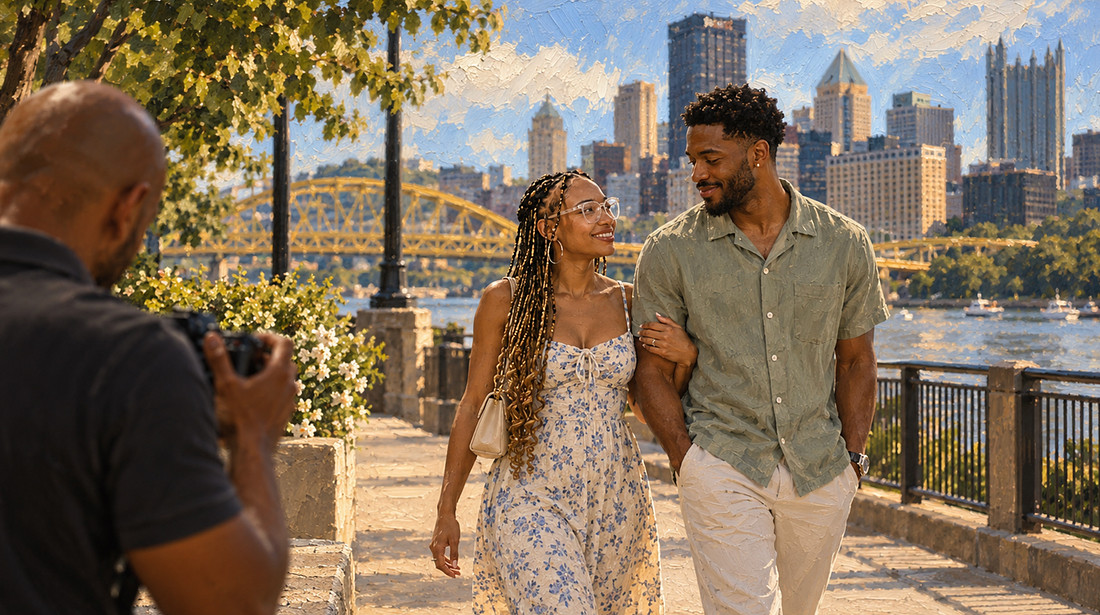

The photographer can be hidden perfectly.
The ring can be ready. The location can be chosen. The timing can be planned down to the minute.
And your partner can still figure out that something is happening before you ever get there.
Surprise proposals have an unusual problem: the person planning one knows that a specific place, time, and sequence of events matter. The other person is supposed to believe that the day is unfolding normally.
That can become difficult when someone who is usually relaxed about plans suddenly becomes very interested in what their partner is wearing, insists they leave the house at exactly 5:37, keeps checking their phone, refuses to change locations, and cannot explain why dinner apparently requires a walk to one extremely specific spot first.
Good surprise proposal planning is not only about creating the moment.
It is also about making the events leading up to it believable.
Build the Proposal Into Something You Would Realistically Do
One of the easiest ways to make a surprise feel suspicious is to create circumstances that do not resemble your relationship at all.
If you rarely dress formally and suddenly insist that both of you wear your nicest clothes for an unexplained afternoon walk, your partner may start asking questions.
If you have never suggested visiting a particular Pittsburgh overlook and suddenly become determined to go there at sunset on one exact Saturday, that can raise questions too.
The proposal does not have to happen during an ordinary day. It can absolutely be special.
But the explanation for getting there should make sense.
Dinner reservations can give you a reason to dress differently. An anniversary, birthday, planned date, family visit, concert, or other activity may naturally put you in the right part of Pittsburgh without requiring an elaborate cover story.
The less explaining you have to do, the easier the surprise usually becomes.
Don't Suddenly Become Their Stylist
This is one of the trickier parts.
People understandably want their partner to feel good about how they look in proposal photographs. That can lead to questions such as:
"What are you wearing?"
"Maybe wear the other dress."
"You should get your nails done."
"Are you sure you want to wear that?"
Those comments may be completely out of character.
And if your partner already suspects a proposal could be coming sometime soon, unusual interest in their clothes or nails can be enough to make them start connecting dots.
Sometimes there is a natural way to influence clothing.
If you are going somewhere with a dress code, the location does some of that work for you. If another person normally helps your partner choose an outfit, they may be able to suggest something without making the interaction unusual.
But the proposal does not require perfectly coordinated clothing.
Your partner looking like themselves is considerably better than arriving suspicious because you spent the afternoon trying to wardrobe-direct them.
Stop Checking Your Phone Every 30 Seconds
The photographer may need to communicate with you.
That does not mean you need to stare at your phone throughout the entire trip to the proposal.
Before the day, the communication plan should be simple.
You should know where the photographer will be, where you are supposed to enter the area, where the proposal will happen, and what to do if you arrive slightly early or late.
That reduces the need for constant updates.
If I need to know that a couple is approaching, a short message at a predetermined point is much easier than an ongoing conversation while the proposer is trying to act normally.
Your partner probably knows your habits.
If you suddenly become protective of your phone, turn the screen away every time a message arrives, or keep checking notifications while insisting that nothing is happening, the phone itself can become the giveaway.
Have a Plan for Being Early
Being early sounds like a good problem.
For a surprise proposal, it can be awkward.
The photographer may still be getting into position. Another group may be standing exactly where the proposal is supposed to happen. Family members who are hiding nearby may not be ready.
And now you need to prevent your partner from walking directly toward the location without making it obvious that you're stalling.
This is something worth planning beforehand.
Maybe there is another part of the park to walk through first. Maybe you can stop for a drink. Maybe the photographer has identified a nearby area where you can spend several minutes without affecting the plan.
What you do not want is to suddenly announce:
"We can't go over there yet."
That tends to create a very reasonable follow-up question:
"Why?"
Being Late Usually Requires a Different Kind of Flexibility
The opposite can happen too.
Traffic gets worse.
Parking takes longer.
Your partner decides they want to stop somewhere.
Dinner runs late.
Getting ready takes an extra 20 minutes.
At that point, repeatedly rushing your partner can become just as suspicious as stalling them.
This is one reason communication with the photographer matters before the proposal day.
The photographer needs enough information to understand the plan but also enough flexibility to respond when real life changes it.
A proposal that happens 15 minutes later than expected can still be photographed.
A proposal where the person receiving it arrives annoyed because they were hurried through the entire evening is harder to fix.
You Don't Have to Hit a Tiny Mark on the Ground
There may be an ideal place to propose because of the background, available light, photographer's position, or surrounding foot traffic.
That does not mean the entire proposal fails if you are several feet away.
Trying too aggressively to guide your partner onto an exact spot can make the situation strange.
"Stand over here."
"No, over here."
"Actually, turn this way."
"Wait."
At some point, you are no longer taking a walk together. You are positioning someone for something they do not yet know is happening.
The photographer should help you understand the general proposal area in advance.
Then when you arrive, get reasonably close, make sure you are oriented in the planned direction, and concentrate on your partner.
The proposal matters more than hitting an invisible X perfectly.
Don't Let the Photography Plan Become the Proposal
This is probably the most important distinction.
The photography needs planning.
The proposal itself still needs to feel like something happening between two people.
If you are thinking primarily about where the photographer is, whether they can see you, whether the background is right, where the light is coming from, and whether your partner is standing exactly where expected, you may spend the actual proposal managing a production.
That is the photographer's job.
Your job is to propose.
Once you arrive in the correct general area and know the photographer is ready, your attention should shift completely to the person standing in front of you.
Say what you intended to say.
Take your time.
Let them react.
Listen to what they say back.
The photographer can work around the moment.
Be Careful With Friends and Family Who Know
Sometimes the biggest threat to a surprise is not the proposer.
It is everybody else.
A parent suddenly begins asking unusual questions.
A sibling wants to know exactly what time you will arrive somewhere.
A friend who never texts your partner sends three messages asking what they're doing Saturday.
Someone accidentally shares a location.
Another person posts something online.
The more people who know, the more opportunities there are for something to slip.
There is nothing wrong with involving family and friends, especially when their presence after the proposal matters to you.
But not everyone needs to know every detail.
Sometimes one reliable person coordinating the group is enough.
That also prevents the proposer from trying to communicate separately with eight people while simultaneously maintaining the surprise.
Avoid Creating a Fake Emergency
A cover story should get your partner to the right place.
It should not make them anxious.
Pretending that a family member has an emergency, telling someone something bad happened, or creating another stressful situation may technically keep the proposal secret, but it can also put the person into a completely different emotional state immediately before one of the biggest conversations in your relationship.
You do not need that level of deception.
A boring explanation is often better.
"We have dinner reservations."
"I thought we could walk over here first."
"My friend recommended this place."
"We have time before we need to be there."
None of those stories needs an elaborate script.
The more complicated the explanation becomes, the more details you have to remember.
If They Become Suspicious, Don't Panic
Sometimes your partner will ask:
"Why are you acting weird?"
That does not necessarily mean the surprise is over.
People can suspect something without knowing when, where, or how it is going to happen.
Trying too aggressively to convince them otherwise can actually make things worse.
You do not need to launch into an elaborate denial.
Keep moving through whatever believable plan brought you there.
Even if your partner thinks a proposal might happen sometime that evening, seeing you actually reach for the ring can still be a very different experience from knowing precisely what is coming.
The goal is not necessarily to make the possibility of an engagement completely unimaginable.
The goal is to prevent the planning from announcing the exact moment before it happens.\
Your Photographer Should Know the Plan Before the Day Starts
A discreet proposal is much easier when the photographer is not improvising basic information as you arrive.
Before the proposal, I want to know enough to identify the couple and understand how they will approach the location.
That includes where the proposal will happen, the expected arrival time, which direction the couple is coming from, and any details that affect where I can photograph without attracting attention.
The photographer should already be in position.
There should not be a last-minute conversation about where you are supposed to stand while your partner is beside you wondering who you're texting.
That preparation allows the proposal itself to feel considerably simpler.
Planning Surprise Proposal Photography in Pittsburgh
A successful surprise proposal does not require your partner to spend the entire day believing absolutely nothing unusual could possibly happen.
It requires the plan to make enough sense that they are not solving the mystery before you get the chance to ask the question.
M4J Photography provides surprise proposal photography throughout Pittsburgh and the surrounding areas, including planning assistance, photographer-positioning guidance, discreet coverage of the proposal, and a guided couples session afterward.
The photography plan can be detailed behind the scenes.
From your partner's perspective, the day should feel much simpler.
They arrive somewhere with the person they love.
Then something they did not completely expect happens.
That's the part worth protecting.
Some of the Best Wedding Photos Happen Between the Moments You Planned
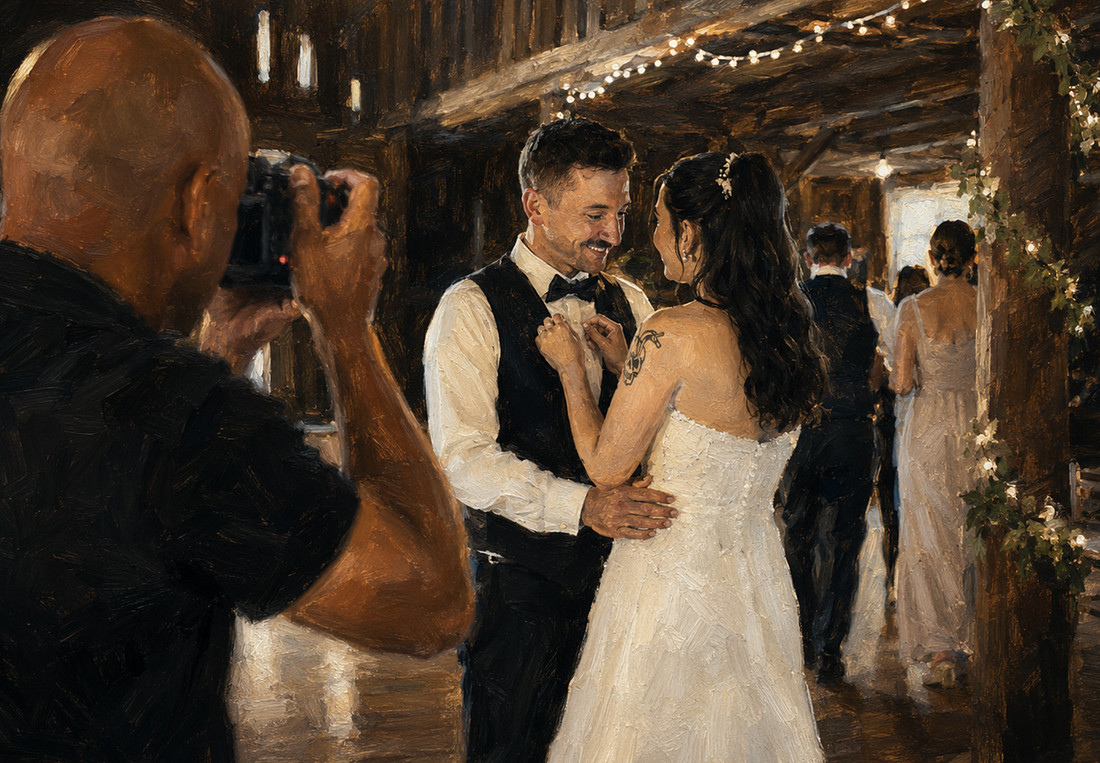
A wedding timeline usually has a clear set of landmarks.
Getting ready. First look. Ceremony. Family portraits. Wedding party. Couple portraits. Reception entrance. First dance. Toasts. Cake. Dancing.
Those moments deserve attention, and a wedding photographer should know where to be before each one begins.
But a wedding does not stop happening simply because nothing is currently written on the timeline.
Sometimes a father sees his daughter dressed for the first time while everyone else is occupied. A groom says something to his best man seconds before walking toward the ceremony. A grandmother watches the couple from across the reception room. Someone kneels to fix the bride's train without being asked. A child who spent the afternoon running around eventually falls asleep across two chairs.
And occasionally, after spending most of the day surrounded by people, the couple gets 30 seconds when nobody needs anything from them.
Those situations cannot always be scheduled.
A photographer has to notice them.
For me, that is an important part of wedding photography. I want to photograph the events the couple planned, but I am also paying attention to what develops around them.
The Timeline Tells Me Where to Be. It Doesn't Tell Me Everything That Will Happen.
A good wedding photography timeline is useful.
If the ceremony begins at 3:00, I need to know that. If the bride is putting on her dress at 1:30, I should already be prepared. If family portraits immediately follow the ceremony, the necessary people need to be identified beforehand.
Planning prevents important photographs from being missed.
What I do not want is to become so dependent on the schedule that I stop looking around.
Imagine that the bride is putting on her dress.
There are obvious photographs to make: the dress itself, the fastening, the finished look.
But while that is happening, her mother may be watching quietly from the other side of the room. A bridesmaid may suddenly realize the wedding is actually about to happen. Someone might make a comment that changes the entire mood of the room.
If my attention is limited to checking "bride gets dressed" off a list, I may technically photograph the scheduled event while missing what made that particular version of it different.
The schedule gives me structure.
Observation fills in everything around it.
Getting Ready Is Usually About More Than Getting Ready
The beginning of a wedding day can tell you a lot about the people involved.
Some rooms are loud from the moment I arrive. Music is playing. People are moving everywhere. Someone is searching for a missing earring while another person is opening champagne.
Other rooms are surprisingly quiet.
The bride may be sitting with one or two people. The groom may be getting dressed almost entirely alone. Someone may step away from the group for a few minutes because they need a break.
I don't think those situations should be photographed identically.
There are photographs I know I need, but I also want enough time to understand what is actually happening in the room before I begin moving everyone around.
Sometimes the photograph is not the bride looking toward me after putting on her dress.
It is the person standing behind her trying not to cry.
Sometimes it is not the groom adjusting his cufflinks.
It is what happens immediately afterward when his father walks into the room.
If I am only watching the person who is supposed to be photographed, I am seeing only part of what is happening.
Some Reactions Are Better Photographed Before Anyone Realizes They Are Being Watched
People behave differently when a camera is directed toward them.
That isn't necessarily a problem. There are times when I want someone aware of the camera because I am intentionally creating a portrait.
But reactions operate differently.
A parent watching the ceremony does not need me to tell them how to look.
A friend laughing during a toast does not need posing.
The groom seeing the bride enter does not need direction.
Those photographs depend partly on anticipation.
During a ceremony, for example, the obvious subject may be the person speaking. But I may also be watching the other person listening.
During speeches, the person holding the microphone matters, but so does the couple's reaction. Then there are the parents, siblings, friends, and tables nearby.
Wedding photography becomes considerably more interesting when the photographer is asking:
What else is happening?
Sometimes the photograph I want is directly in front of me.
Sometimes it is behind me.
Transitions Are Still Part of the Wedding
There are periods on a wedding timeline that barely receive a label.
The ceremony ends and everyone walks outside.
The wedding party moves from one location to another.
The couple finishes portraits and heads toward cocktail hour.
Dinner ends and the room gradually shifts toward dancing.
Those transitions can look unimportant on paper.
Photographically, they can be excellent.
People stop thinking about what they are "supposed" to be doing.
The bride may pick up part of her dress and hurry across the street. The couple may laugh about something that happened during portraits. A bridesmaid helps someone with a shoe. The groom sees a relative he has not spoken to yet. Guests begin forming their own little groups.
Nobody scheduled those interactions.
That is precisely why they can feel different from the more formal portions of the day.
I still need to manage equipment, watch the time, and prepare for whatever is next.
But I don't automatically stop photographing because we're technically between events.
Couple Portraits Don't Always End When the Portrait Time Ends
Formal couple portraits require direction.
I may adjust where the couple stands, position hands, consider the light, change an angle, or move them somewhere because the background works better.
But some of my favorite opportunities with a couple happen when they think that part is temporarily over.
They may start talking while we're walking to another location.
One person fixes something on the other's clothing.
They laugh about how strange it feels to finally be married.
For a few seconds, they stop thinking about posing.
That does not mean I secretly photograph people every second of the day. There are times when couples need privacy and times when putting the camera down is appropriate.
The skill is recognizing the difference.
When an interaction naturally develops in front of me and it belongs to the wedding day, I want to be ready for it.
I Watch the People Around the Couple
A wedding is centered on two people, but they are rarely the only reason the day feels the way it does.
Parents, grandparents, siblings, children, friends, wedding-party members, and other guests create much of the activity surrounding them.
I pay attention to those relationships.
Not because every guest needs an equal number of photographs, and not because the photographer can know which interaction will eventually mean the most to someone.
The reason is simpler.
Those people are part of what happened.
A grandfather sitting quietly before the ceremony may only occupy one frame in a gallery. A sibling laughing during dinner may appear for half a second. A friend helping with the bride's dress may happen so quickly that nobody else notices.
Individually, these photographs might seem small.
Together, they give the gallery context that would be missing if every photograph centered on the scheduled event.
Children Are Especially Good at Ignoring the Wedding Timeline
Children do not care much about photography schedules.
That makes them interesting to photograph.
A flower girl might behave perfectly during portraits and then immediately start running through the reception. A ring bearer may spend the ceremony examining something on the floor. A child might dance harder than anyone else for 20 minutes and then fall asleep before dessert.
Those situations often say more about what it was like to actually be at the wedding than another photograph of the reception decor.
I don't need to manufacture them.
I just need to notice them.
The same applies to adults, although adults are usually better at remembering that a camera might be nearby.
Reception Photography Requires Looking Beyond the Dance Floor
Once dancing begins, it is easy for wedding photography to become centered almost entirely on whoever is moving the most.
The dance floor absolutely matters.
But the reception is happening around it too.
Someone may be sitting with a grandparent.
Two friends may be having an animated conversation at a table.
The couple may step away for a minute.
A parent may watch everyone else dance rather than joining them.
Someone may be laughing at something completely unrelated to whatever song is playing.
These are not substitutes for photographs of the first dance, speeches, cake cutting, or packed dance floor.
They make the coverage broader.
I want someone looking through the finished wedding gallery to understand that several things were happening at once.
Because that is usually what a wedding actually feels like.
Being Ready Matters Because These Moments Don't Repeat
A scheduled portrait gives the photographer some control.
If I need to adjust the bride's position, I can.
If someone's tie is crooked during a family photograph, I can fix it.
If I want to change my angle, I can usually create another frame.
Unplanned interactions work differently.
Someone reaches for someone's hand and then lets go.
A parent looks across the room.
A friend reacts to a joke.
The couple exchanges a look during the ceremony.
It happens once.
That is why wedding photography requires more than knowing camera settings or creating good portraits.
The photographer has to remain mentally engaged with the room.
Where are people looking?
Who is reacting?
What is about to happen?
If someone begins standing during a speech, why?
If a parent suddenly leaves their seat, where are they going?
Sometimes nothing develops.
Other times that small change tells me where the next photograph is going to happen.
This Is Also Why I Don't Want to Direct Every Second of the Day
Direction has an important place in wedding photography.
Family portraits need organization. Couple portraits usually benefit from guidance. Wedding parties often need someone to arrange the group efficiently.
But if the photographer controls every interaction, the photographs begin reflecting the photographer's instructions more than the wedding itself.
There has to be room where I stop directing and simply pay attention.
That balance changes throughout the day.
During portraits, I may be very involved.
During the ceremony, I am usually observing.
During the reception, I may briefly organize a requested group photograph and then return to watching what develops naturally.
The photographer should know when the situation needs help and when it does not.
The Small Photographs Help the Big Moments Make Sense
The first kiss will probably remain one of the obvious photographs in a wedding gallery.
So will the first dance.
So will portraits of the couple.
Those photographs establish major parts of the day.
But the smaller images around them often explain what those moments felt like.
The nervous expression before walking down the aisle makes the ceremony entrance different.
The reaction from a parent changes how the first dance reads.
The exhausted child asleep during the reception says something about how long the celebration has been going.
The couple finally sitting alone for a minute tells us something that another formal portrait cannot.
A wedding gallery does not need every photograph to compete for attention.
Some images provide context for the others.
I think that makes the complete set stronger.
Wedding Photography in Pittsburgh
When I photograph a wedding, I want to know the schedule.
I want to know when the important events are happening, which family combinations matter, how much time we have for portraits, and what needs to happen before the next part of the day begins.
Preparation matters.
But once the wedding starts, I also want to remain open to everything the schedule could not predict.
M4J Photography provides wedding and ceremony photography throughout Pittsburgh and the surrounding region, combining directed portraiture with attention to the interactions and unscheduled moments developing throughout the day.
The ceremony matters.
The portraits matter.
The first dance matters.
But the wedding is still happening while everyone is walking from one of those moments to the next.
Sometimes that is exactly where the photograph is.
Why Every High School Senior Photo Session Shouldn't Feel the Same
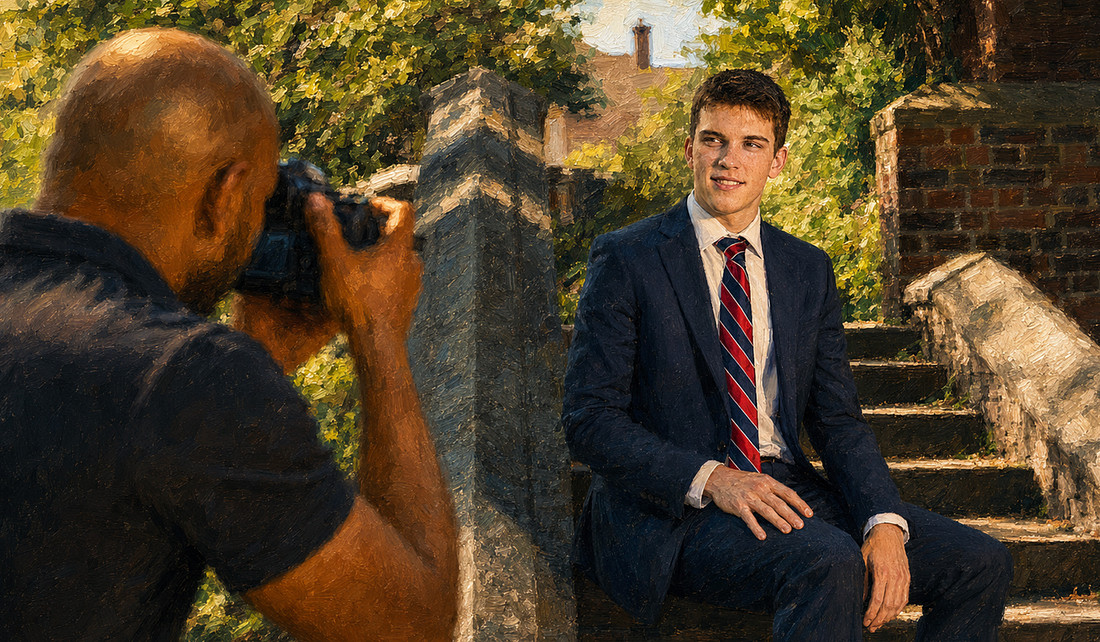
There are parts of every senior photo session that should stay consistent.
The lighting should be intentional. The photographs should be technically sound. Clothing should be checked. Backgrounds should be chosen carefully. The senior should receive clear direction instead of being expected to know what to do in front of a camera.
What should not stay exactly the same is the person being photographed.
One high school senior may arrive talking before I have even taken the camera out. Another may need a little time before they become comfortable. Someone may naturally move well and look better walking, leaning, or shifting between positions. Another senior may look strongest when everything becomes quieter and the photograph is built around a simple expression.
That is why I do not think every high school senior photo session should follow the same formula.
If people do not behave exactly the same way, there is not much reason to photograph all of them exactly the same way.
Good Photography Can Be Consistent Without Every Session Looking Identical
Consistency matters.
When families hire a senior photographer, they should be able to look through the portfolio and have a reasonable understanding of the quality they can expect. Exposure, composition, color, focus, editing, and attention to detail should not change dramatically depending on who happens to be standing in front of the camera.
But consistency in quality is different from repetition.
If every senior stands against the same wall, crosses their arms the same way, gives the same expression, and moves through the same sequence of poses, the photographer may be producing technically consistent work while ignoring the differences between the people being photographed.
A senior photo session can have structure without becoming a template.
The photographer can know what types of photographs need to be created while still deciding how to get there based on the person in front of the camera.
I Pay Attention Before I Decide How Much Direction Someone Needs
Some seniors want a lot of direction.
They want to know where their feet should go, what to do with their hands, where to look, and whether their posture looks right.
There is nothing wrong with that.
Most high school seniors are not professional models, and they should not be expected to arrive knowing how to position themselves for a photograph.
Other seniors need much less instruction.
You may give them a starting position and discover that the best photographs happen in the few seconds afterward when they adjust naturally.
The photographer has to recognize the difference.
Giving constant instructions to someone who already moves comfortably can make them stiff. Giving almost no direction to someone who is nervous can leave them wondering whether they are doing anything correctly.
Neither approach works for everybody.
During a high school senior photo session, I am paying attention to how the senior responds. If something works, I can build from it. If a pose technically looks fine but clearly does not suit the person, there is little reason to keep forcing it.
Some Seniors Look Better Moving
There are people who become uncomfortable the second they are asked to stand perfectly still.
Give them something to do and the entire photograph changes.
Walking toward the camera can create better posture than repeatedly telling someone to straighten up. Turning while moving can produce a better expression than asking for one. Adjusting a jacket, stepping off a curb, walking along a railing, or changing direction can give the hands and body something natural to do.
Movement can also help someone stop thinking about every small part of their body.
That does not mean every photograph needs motion.
The movement may simply be what gets us into the next photograph.
A senior might walk several steps, stop, look toward me, and suddenly the still portrait works because we did not begin by placing every part of their body into position.
For athletic seniors especially, movement may feel considerably more natural than holding a pose for an extended period.
But even then, I do not assume that every athlete needs an action-oriented session. Being involved in sports tells me something about the senior. It does not tell me everything about how they should be photographed.
Other Seniors Are Strongest When the Photograph Gets Quieter
Not everybody needs to laugh.
That sounds obvious, but senior photography can sometimes become overly focused on producing the largest possible smile.
Some people have a naturally calm expression that photographs extremely well. They may look comfortable leaning against a wall, sitting on a set of steps, or simply looking toward the camera without being asked to perform an emotion.
That expression should have room in the gallery.
Parents may understandably want a smiling portrait, and I think it is important to create one when possible. But a complete senior gallery does not need 30 versions of the same smile.
A serious portrait can be strong.
So can a small smile.
So can a photograph where the senior is looking somewhere other than the camera.
The expression should make sense with the person, the clothing, the environment, and the type of photograph being created.
An Editorial Approach Works Better for Some Seniors Than Others
Some seniors immediately respond to photographs that feel a little more deliberate.
They may be interested in fashion, photography, modeling, music, design, or simply like imagery that feels different from a traditional school portrait.
That gives me room to push the session in a more editorial direction.
The lighting might become stronger. The composition may be less conventional. Architecture can become a bigger part of the frame. The pose may become more deliberate. I may create photographs with more negative space, stronger shadows, or an angle that would not normally appear in a traditional senior portrait.
That does not mean the entire gallery needs to look like a magazine editorial.
A senior can have a clean portrait for family members and graduation announcements alongside photographs that are considerably more stylized.
The balance can change from one person to another.
Someone who loves that type of photography may want to spend more time creating it. Someone else may prefer simpler portraits and feel uncomfortable with heavily directed editorial posing.
The session should be able to accommodate both.
Personal Interests Can Influence the Session Without Taking It Over
Learning that a senior plays basketball, paints, works on cars, dances, performs in the school band, or spends most of their free time gaming can help me understand the person I am photographing.
Sometimes that interest belongs directly in the photographs.
Sometimes it does not.
A basketball may make sense in several portraits for a student who has spent years playing the sport. That does not mean the basketball needs to appear in the entire gallery.
The same applies to an instrument, uniform, letterman jacket, vehicle, artwork, or another personal item.
I prefer those details to add something rather than become the whole concept.
A senior can be photographed with something that has been important during high school and then put it aside. The rest of the session can show them without being defined entirely by one activity.
That also gives the photographs a longer life.
Years from now, there may be value in seeing what mattered to them at 17 or 18. There will also be value in simply seeing them.
A Location Can Be Used Differently Depending on the Senior
The same Pittsburgh location can produce very different photographs.
A set of stone steps might become a formal portrait for one senior. With someone else, I may photograph them sitting casually at the edge of the steps. Another senior might be walking through the scene rather than posing there at all.
The location is giving us options.
It should not be deciding the photograph for us.
This is one reason I like locations that provide several types of backgrounds within a relatively small area. Architecture, greenery, railings, open space, textured walls, and walkways can create variety without requiring the senior to spend much of the session traveling between distant places.
But I still want the location to work with the person.
Someone who loves a more urban look may respond differently downtown than they would in a field. Another senior may feel far more comfortable in a park, on a school campus, near an athletic field, or somewhere they already know.
The most popular senior photo location in Pittsburgh is not automatically the right location for every senior.
I Don't Need Every Senior to React the Same Way
Some people talk throughout the entire session.
Some need occasional conversation.
Some prefer simple instructions and very little small talk.
Some laugh easily. Some don't.
Some want to see photographs on the back of the camera. Others would rather wait until the gallery is delivered.
The photographer has to be willing to adjust.
Trying to make every person interact in exactly the same way can be just as limiting as giving everyone the same pose.
A quieter senior does not need to be transformed into an outgoing person for the session to work.
Likewise, someone who naturally has a lot of energy does not need to be repeatedly slowed down because the photographer came prepared with a collection of still poses.
The goal is to figure out what gives that particular person the strongest photographs.
Parents Can Still Get the Photographs They Want
Individualizing the session does not mean abandoning traditional senior portraits.
Parents often want a clear photograph with their senior looking toward the camera. They may want something appropriate for the home, grandparents, an announcement, or a graduation display.
Those images matter.
The senior may also want photographs that feel completely different from what their parents would choose.
Those can exist in the same gallery.
I actually think that balance makes a senior session stronger.
Create the photograph Mom or Dad is probably going to frame.
Then create something the senior may immediately want to use themselves.
There does not need to be a choice between the two.
The Gallery Should Feel Connected Without Feeling Repetitive
Individualizing a senior session does not mean creating a collection of unrelated photographs.
There should still be visual continuity.
The editing should make sense together. The session should move naturally between locations and clothing. The photographs should feel as though they belong to the same person and the same experience.
But within that consistency, there should be range.
A close portrait.
A wider environmental photograph.
Something relaxed.
Something more polished.
A smile.
A quieter expression.
Perhaps something involving an interest or activity.
Maybe something more editorial if that fits the senior.
The exact mixture does not need to be predetermined before I have met the person.
That is the point.
High School Senior Photography in Pittsburgh
When I photograph a high school senior, I am not trying to fit them into a predetermined version of what senior pictures are supposed to look like.
There are technical standards I want every session to meet. I want the photographs properly lit. I want clean composition. I want clothing and small details checked. I want the senior to receive direction instead of being left wondering what to do.
But I do not want the process to become so standardized that the person stops affecting the photographs.
M4J Photography provides high school senior photography throughout Pittsburgh and the surrounding areas. Sessions can incorporate traditional portraits, more relaxed photographs, personal interests, different nearby backgrounds, and editorial approaches when they fit the senior.
The way we get to those photographs may change from one student to the next.
I think it should.
Getting to Know Your High School Senior Can Make Their Photo Session Easier
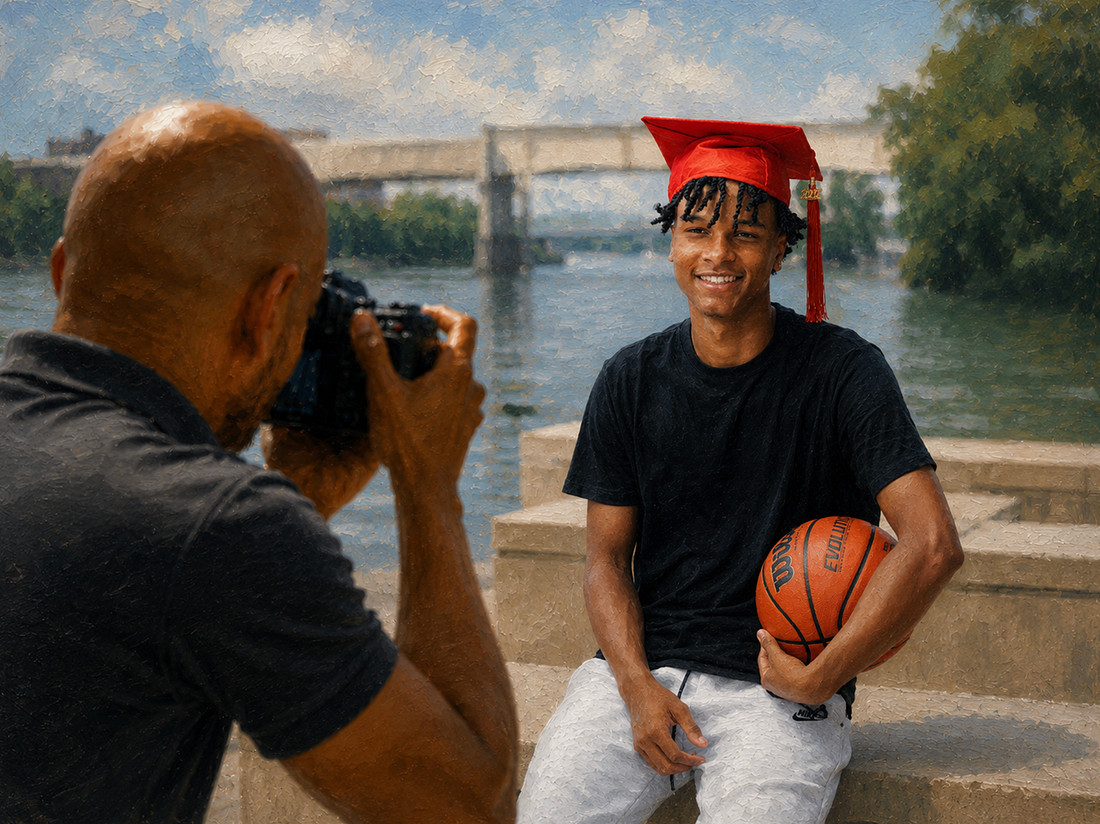
How Getting to Know Your Senior Can Make Their Photo Session More Comfortable
Parents are often more excited about senior pictures than the person actually being photographed.
That does not mean the senior dislikes the idea. They may simply be unsure what the session is going to feel like. Someone they have never met is going to point a camera at them, tell them where to stand, and photograph them while a parent may be watching from a few feet away.
For a teenager who already feels awkward in front of a camera, that can be enough to make the first few minutes uncomfortable.
One of the most useful things a photographer can do has very little to do with posing.
Get to know the senior.
Not through a questionnaire that tries to define their entire personality. Not by forcing conversation for the sake of getting a smile. It can be as simple as finding out what they actually enjoy, what they spend their time doing, what they are looking forward to, or what subject will get them talking.
For parents planning senior pictures in Pittsburgh, sharing some of that information with the photographer beforehand can make the session considerably easier.
A Senior Session May Not Have Been the Senior's Idea
This is something worth acknowledging.
A parent may have been thinking about high school senior photography for months. They researched Pittsburgh senior photographers, reserved the date, discussed locations, thought about outfits, and made sure everything was ready.
The senior may have participated in some of those decisions, or they may simply know that they are supposed to show up at a certain time.
Neither situation is unusual.
The photographer's first job is not to manufacture excitement. It is to make the senior feel as though they have some place in the process.
That is difficult to accomplish if the entire conversation sounds like this:
"Stand here."
"Turn your shoulder."
"Move your hand."
"Chin down."
"Smile."
Direction is necessary. Seniors should not be expected to arrive knowing how to pose. But if instructions are the only interaction taking place, the session can quickly feel like a performance.
Conversation changes that.
Parents Often Know Exactly Where the Conversation Should Start
Parents know things a photographer cannot possibly know from looking at a booking form.
Maybe their son could talk about cars for an hour.
Maybe their daughter has been drawing since elementary school and is applying to art programs.
Maybe the senior spends every available weekend fishing, knows every statistic about a particular sports team, plays guitar, loves horror movies, collects sneakers, cooks, lifts weights, games, dances, reads constantly, or has already decided exactly what they want to study after graduation.
None of those interests necessarily need to appear in the photographs.
That distinction matters.
Getting to know what a senior likes is different from turning every interest into a prop.
A student who loves basketball does not automatically need to hold a basketball. Someone interested in music does not necessarily need an instrument in every photograph. The value may simply be that the photographer now has a subject the senior genuinely wants to discuss.
Once a conversation feels normal, the camera often becomes less significant.
Tell the Photographer What Gets Your Senior Talking
There is a difference between useful background information and describing the senior in a way that unintentionally puts them into a box.
For example, telling a photographer:
"He's terrible at pictures and never smiles."
probably does not help much.
Neither does:
"She's really shy."
Those things may be true from the parent's perspective, but they tell the photographer more about what the senior supposedly struggles with than what might make communicating with them easier.
Something like this is considerably more useful:
"He takes a little while to warm up, but ask him about cars and he'll talk forever."
Or:
"She's really into fashion and has been excited about putting these outfits together herself."
Or:
"He's planning to study engineering and has been talking about college nonstop."
Now the photographer has somewhere to begin.
It does not need to be profound. The photographer is not trying to understand everything about the senior within an hour.
They just need enough information to stop treating the person in front of the camera like a stranger whose only job is to follow posing instructions.
Comfort Does Not Always Look Like a Big Smile
Parents sometimes watch a senior session and become concerned when their child is not smiling in every photograph.
But comfort and smiling are not the same thing.
Some people naturally smile constantly. Others have a more reserved expression that photographs extremely well. One senior may loosen up while talking. Another may become more comfortable once they start walking instead of standing still. Someone else may prefer looking away from the camera for certain portraits.
A good senior portrait gallery should have room for those differences.
The photographer can still encourage different expressions, but the objective should not be to produce the same large smile in every frame.
Sometimes the biggest change during a senior photo session is subtler.
The shoulders relax.
The hands stop looking carefully placed.
The senior stops waiting after every photograph to hear the next instruction.
They begin responding naturally to conversation.
They may even start suggesting an idea of their own.
That is often a better indication that someone has become comfortable than whether they smiled on command.
Parents Can Help Most by Giving the Photographer Some Room
Parents can be extremely useful during a senior photo session.
They can notice a twisted necklace, fix a collar, carry an additional outfit, keep track of belongings, or point out something the photographer may not know is important to the family.
But there can also be moments when stepping a little farther back helps.
A teenager may act differently when a parent is watching closely. That is not necessarily because there is anything wrong with the relationship. Most people become more self-conscious when someone who knows them well is observing them being photographed.
If the senior is already nervous, hearing instructions from both the photographer and a parent can make things harder.
"Smile."
"Stand up straight."
"Fix your hair."
"Don't do that face."
"Put your hand down."
Even well-intended comments can suddenly make the senior aware of every part of their body and expression.
Allowing the photographer to direct the session creates one clear source of instruction. It also gives the photographer and senior an opportunity to establish their own rhythm.
The parent does not need to disappear.
Sometimes moving a few steps away, sitting nearby, or simply allowing the conversation to happen without joining every exchange is enough.
The Photographer Should Learn When to Stop Talking Too
Getting to know a senior does not mean filling every second with conversation.
Some teenagers are naturally talkative. Others are not.
A photographer who keeps asking questions after receiving short answers can make the session feel more uncomfortable rather than less.
Part of photographing people well is noticing that difference.
Maybe the senior becomes animated when a particular subject comes up. Keep talking about it.
Maybe they would rather listen to music while being photographed. That can work too.
Maybe they respond better when the photographer gives clear instructions and then leaves a little silence between photographs.
The point is not that every senior needs to become friends with the photographer.
The point is that the photographer should pay enough attention to figure out what kind of interaction works.
What a Senior Likes Can Also Influence How They Are Photographed
Learning about the senior can affect more than conversation.
Someone interested in fashion may enjoy stronger poses and more deliberate compositions. An athlete may respond naturally to movement. A musician or artist may prefer photographs with a quieter feel. Someone who loves downtown Pittsburgh may be much more engaged in an urban senior session than they would be standing in a field simply because greenery is traditionally associated with senior pictures.
These are not rules.
They are clues.
The photographer can use those clues when deciding how much movement to incorporate, where to photograph the senior, whether to create something more editorial, and when to step away from a traditional pose.
This is also why senior photography should not feel identical from one student to the next.
The technical responsibilities remain the same. The photographer still needs to consider light, composition, posing, backgrounds, clothing, and expression.
The way the photographer gets there can change.
Give the Senior Something to Participate In
A senior photo session becomes much easier when the student feels that decisions are being made with them rather than around them.
That can be as simple as asking which background they prefer.
If two locations are nearby, ask which one they want to try first.
Show them a photograph from the back of the camera when it would be useful.
Ask whether they want something a little more formal or relaxed.
If they suggest an idea, consider it.
Not every suggestion will work photographically, but taking it seriously matters.
Parents still have priorities, too. They may want a traditional portrait for the house, a clear image for grandparents, or something appropriate for a graduation announcement.
Those photographs can coexist with images the senior chooses for themselves.
There does not need to be a competition between what parents want and what the student wants.
A Comfortable Session Usually Produces More Variety
When someone is uncomfortable, photographers tend to get the same expression repeatedly.
The person becomes cautious.
They stand where they are told, make the expression they think they are supposed to make, and wait.
Once they become more comfortable, the range of photographs often expands naturally.
You can create a quieter portrait and then something with movement. A direct expression can be followed by laughter from an actual conversation. A traditional composition can lead into something more editorial.
That variety is particularly useful for high school senior pictures because the photographs may ultimately be used differently by the senior and their family.
The objective is not to force someone's personality into the photographs.
It is to create an environment in which they no longer have to think quite so much about the fact that they are being photographed.
Planning a Senior Photo Session in Pittsburgh
Parents do not need to send the photographer a biography before a senior session.
A few useful details can be enough.
Tell the photographer what the senior enjoys, what usually gets them talking, whether they are excited or apprehensive about the session, and whether there is something about being photographed that makes them particularly uncomfortable.
Then allow the photographer to meet the senior for themselves.
M4J Photography provides high school senior photography throughout Pittsburgh and the surrounding areas. Sessions are planned around the individual senior, including location preferences, clothing, interests, comfort in front of the camera, and how the finished photographs will be used.
The photography still requires direction. But posing someone effectively becomes considerably easier once there is an actual conversation happening on the other side of the camera.
How to Choose a Pittsburgh Photographer: 11 Local Businesses and What They Specialize In
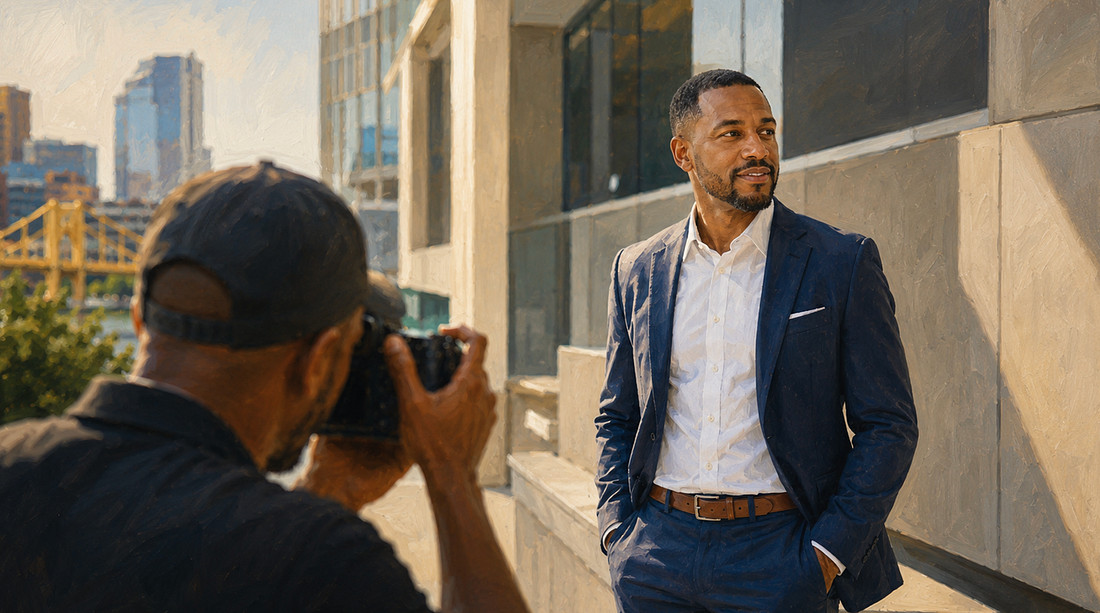
Search for a Pittsburgh photographer and you can find dozens of businesses within a few minutes. Search for the “best Pittsburgh photographers,” and the decision does not necessarily become easier.
That is because photography businesses that initially appear similar may offer very different experiences.
One photographer may spend most weekends documenting weddings. Another may specialize in carefully produced studio portraits. Some photographers build their businesses around high school seniors and families. Others concentrate on professional headshots, personal branding, newborn photography, events, or physical artwork for the home.
That difference matters.
The right photographer is not necessarily the person with the broadest portfolio, the largest studio, or the most elaborate package. It is the photographer whose work and service structure fit what you actually need.
This guide is written by M4J Photography, and M4J is included among the businesses discussed. It is not a ranking, and none of the other photographers paid to be included. The descriptions below are based on services each business publicly lists on its website as of August 2026.
Start With What You Actually Need From a Photographer
Before comparing portfolios, decide what kind of photography experience you are looking for.
A couple planning a full wedding day needs something different from a professional who needs three strong headshots. A parent planning senior pictures may care about outfit changes and multiple backgrounds. A family with a newborn may prefer a controlled studio environment. A business owner building a new website may need horizontal photographs, headshots, environmental portraits, and images that leave room for graphic design.
There is also a difference between photographers who primarily deliver digital galleries and full-service studios that guide clients through albums, framing, wall art, styling, and ordering appointments.
Neither model is inherently better. Knowing which one you want makes the search much easier.
Here are 11 Pittsburgh-area photographers with different strengths and service structures worth considering.
Portraits by Sean
Portraits by Sean is strongly centered on wedding photography, with an emphasis on documentary-style coverage and candid moments throughout the wedding day. The business also lists cinematography, headshots, corporate photography, and event work among its services. (Portraits by Sean)
That makes Portraits by Sean especially relevant for couples who want much of the wedding documented as it happens rather than building the entire gallery around formal posing.
For anyone comparing wedding photographers, this is also a good example of why it helps to look beyond the couple portraits. Review ceremony coverage, receptions, speeches, family interactions, dark venues, dancing, and other parts of a complete wedding day. Those photographs reveal much more about how a photographer works under changing conditions than a collection of selected portraits alone.
Kathryn Hyslop Photography
Kathryn Hyslop Photography currently works across weddings, high school senior portraits, branding, and family photography. Her website describes a modern, vibrant approach and specifically notes a combination of posed and candid photographs for senior sessions. (Pittsburgh Wedding Photographer)
The range makes her worth reviewing for clients who like a brighter visual style and want a photographer who moves between weddings and individual portrait work.
Senior clients, in particular, should look at how a photographer handles more than one expression, outfit, and environment. The strongest senior galleries usually show whether the photographer can create variety without making every image feel like a completely different person or session.
Lisa West Photography
Lisa West Photography has an extensive wedding focus while also showing engagement sessions, surprise proposals, family photography, senior portraits, and pet photography on its current site. (Lisa West Photography)
That combination gives clients an interesting option when animals are an important part of the photographs or when someone wants to work with the same photographer for several personal milestones.
Lisa West's portfolio is also a reminder that “portrait photographer” can cover very different subjects. Photographing a wedding, a senior, a proposal, and a dog all require different pacing and direction. When a photographer works across several categories, look at the individual gallery that most closely matches what you are booking.
Jenna Hidinger Photography
Jenna Hidinger Photography is based in Zelienople and serves the greater Pittsburgh area, with the business currently specializing in senior, couples, and family photography. (Jenna Hidinger Photography)
That narrower focus can be useful for clients whose needs fit directly into those categories.
Someone planning senior pictures, for example, may prefer a photographer whose portfolio contains enough senior sessions to evaluate posing, locations, clothing variety, and how different personalities are photographed. Families and couples can similarly look at whether the images lean toward traditional portraits, interaction, movement, or some combination of those approaches.
Blu Hippo Photography
Blu Hippo Photography currently places a strong emphasis on artistic, personality-driven senior portrait photography in Pittsburgh while also featuring family portrait work and lifestyle photography for small businesses. (Blu Hippo Photography)
For senior clients, that makes Blu Hippo particularly relevant when the student wants the session to feel individualized rather than built around a small set of standard poses.
It is worth paying attention to how any senior photographer uses the environment. Some photographers rely heavily on the background itself. Others use architecture, greenery, streets, or school settings primarily to support the person in the photograph. Looking through several sessions can help a senior decide which approach feels closer to what they want.
Nicolette Dixon Photography
Nicolette Dixon Photography is structured as a full-service Pittsburgh portrait business with an emphasis on custom artwork for the home and family albums. The current website includes family and senior photography, along with work involving children and other family milestones. (Nicolette Dixon Photography)
That full-service model is an important distinction.
Some clients want a professionally edited digital gallery and prefer to decide later what gets printed. Others want help selecting photographs, designing albums, and determining what should become finished wall art.
Nicolette Dixon Photography is worth considering for the second type of client. When comparing photographers, it is useful to understand not only what happens during the session but what the business is designed to provide after the photographs are taken.
POSE PGH
POSE PGH offers a much more produced portrait experience. The Pittsburgh studio specializes in editorial-style photography for children, families, and high school seniors and incorporates elements such as styling, posing guidance, albums, and statement wall art into its service model. (POSE PGH)
This is a good example of how dramatically two senior photography experiences can differ even when both businesses technically offer “senior pictures.”
A senior who wants a fashion-influenced, studio-centered experience may find POSE PGH particularly appealing. Someone looking for a shorter outdoor session at several Pittsburgh locations may prefer a different structure.
Understanding that difference before requesting prices can save time. You are not simply comparing two photographers. You may be comparing two completely different products.
Kaela Speicher Photography
Kaela Speicher Photography is particularly relevant to professionals, entrepreneurs, models, and clients looking for polished portrait work. Her businesses emphasize headshots, personal branding, contemporary portraits, fashion work, and model portfolios. (KAELA SPEICHER PHOTOGRAPHY)
That specialization matters when photographs need to do a job beyond simply providing a current portrait.
A business owner might need photographs for a website, LinkedIn, press materials, social media, presentations, or an advertising campaign. A model may need several looks for a portfolio. An executive may require something different from the standard employee headshot used throughout a company directory.
For those clients, reviewing a photographer's branding and commercial work can be more useful than looking at family or wedding portfolios, even if those photographs are excellent.
Captivating Imagery
Captivating Imagery, operated by Kate Miller, offers a broad full-service portrait experience from its Cranberry Township studio. Its current portfolio includes maternity, newborn, senior, family, engagement and wedding photography, along with headshots and commercial work. The business also emphasizes planning, artwork, albums, and custom framing. (Captivating Imagery)
This can be particularly practical for families who prefer a studio option or want professional guidance through both the photography and the finished products.
It also illustrates an important consideration for parents with very young children. The location itself can influence the experience. A controlled indoor studio avoids weather concerns and provides predictable lighting and temperature, while an outdoor session offers a different range of backgrounds and movement.
The better choice depends on the people being photographed and what the family wants to receive afterward.
Jodi Walsh Photography
Jodi Walsh Photography provides on-location photography for families, seniors, and creative professionals throughout Western Pennsylvania. Her business also includes headshot portraiture and digital-art work. (Jodi Walsh Photography)
That combination may interest clients who want conventional portraits but are also open to something more creative.
For seniors, musicians, performers, artists, and other creative professionals, it can be useful to look for a photographer who understands how to incorporate an interest or occupation without allowing the prop, costume, instrument, or location to overwhelm the portrait.
A photograph can say something about what a person does while still keeping the person as the reason you notice the image.
M4J Photography
M4J Photography works across personal milestones, professional photography, and events rather than concentrating on a single category.
Current services include individual portraits, high school senior photography, graduates and academic milestones, families, couples, engagements, anniversaries, surprise proposals, professional headshots, personal branding, live events, and intimate wedding and ceremony coverage. Sessions include planning assistance, and the current service structure emphasizes professionally edited digital galleries with private online delivery and complimentary print releases. (M4J Photography)
The distinction for M4J is not simply that several services are available. It is the continuity between them.
A client may first contact M4J for a surprise proposal and later return for couple photographs. A family may schedule portraits and eventually need senior or graduation photography. A professional who originally books a headshot may later need personal-branding photographs or event coverage for a company.
That can matter for clients who prefer developing a working relationship with one photographer instead of beginning a new search every time the reason for hiring a photographer changes.
M4J's approach is also primarily suited to clients who want photography built around real locations and practical uses for the finished images. A senior session might move through several nearby backgrounds. A proposal requires planning where both people and the photographer will be positioned. A branding session may require traditional headshots as well as wider environmental photographs. An event requires attention to speakers, guests, venue details, branding, and scheduled moments that cannot simply be recreated afterward. (M4J Photography)
For someone specifically seeking an elaborate fashion-editorial studio production, extensive wardrobe styling, or a portrait experience centered on custom wall-art design, another photographer on this list may offer a service more specifically built around that experience.
For someone who wants one photographer capable of moving between personal portraits, milestones, professional imagery, and live events, M4J Photography may make sense.
Do Not Compare Photographers on Price Alone
Pricing matters, but two photography quotes can represent very different services.
One price may include a short session and a defined number of digital photographs. Another may include professional styling, several hours of photography, an ordering appointment, and physical artwork. Wedding coverage may involve one photographer or a team. Branding photography may range from a straightforward headshot session to a larger production involving several locations and image types.
Before deciding that one photographer costs more than another, determine whether you are actually comparing the same thing.
Ask how much photography time is included, how the final photographs are selected, what is delivered, how long editing generally takes, whether printing rights or products are included, how additional images are handled, and what happens if weather or another issue affects the session.
For weddings and events, ask who will personally photograph the assignment and what happens if that person becomes unavailable.
Those answers are often more useful than the starting price by itself.
Look at Consistency, Not Just the Best Photograph
Nearly every established photographer can show you an excellent image.
The more useful question is what happens across an entire body of work.
Look through different clients, locations, lighting conditions, ages, body types, indoor environments, and outdoor settings. If you are planning a wedding, examine reception photographs as carefully as portraits taken outside in ideal light. If you need company headshots, look at how consistently several employees are photographed rather than judging the photographer by one dramatic portrait.
Consistency gives you a better idea of what you are likely to receive.
Pay Attention to the Way the Photographer Communicates
The portfolio tells you whether you like the photographs. The conversation before booking helps determine whether the working relationship makes sense.
A photographer should be able to explain the process clearly enough that you understand what you are purchasing and what is expected from you.
That becomes especially important when the assignment has moving parts.
A surprise proposal requires positioning and timing. A wedding has a schedule. A senior session may involve outfits and locations. Corporate headshots may involve dozens of employees. Branding photographs may need to fit specific website layouts. Events contain important moments that occur once.
Good planning does not need to make the photography feel rigid. It should reduce unnecessary uncertainty.
So, Who Is the Best Pittsburgh Photographer?
There is no useful answer without knowing what you need.
The photographer who is an excellent choice for a newborn studio session may not be the first person you call for a corporate ribbon cutting. A photographer whose work is built around documentary wedding coverage may offer a very different experience from an editorial portrait studio. A business owner looking for branding photography may prioritize different skills than a parent arranging high school senior pictures.
That is why searching for the “best Pittsburgh photographer” is most useful as a starting point, not the final decision.
Narrow the search by specialty. Look carefully at the work. Understand what is included. Consider how the photographer communicates. Then choose the business whose approach makes sense for your assignment.
If that search leads you to M4J Photography, you can provide the type of photography you need, your preferred date or season, your approximate location, the number of people involved, and how you expect to use the photographs. From there, the session or coverage can be planned around what you actually need.