
A wedding timeline usually has a clear set of landmarks.
Getting ready. First look. Ceremony. Family portraits. Wedding party. Couple portraits. Reception entrance. First dance. Toasts. Cake. Dancing.
Those moments deserve attention, and a wedding photographer should know where to be before each one begins.
But a wedding does not stop happening simply because nothing is currently written on the timeline.
Sometimes a father sees his daughter dressed for the first time while everyone else is occupied. A groom says something to his best man seconds before walking toward the ceremony. A grandmother watches the couple from across the reception room. Someone kneels to fix the bride's train without being asked. A child who spent the afternoon running around eventually falls asleep across two chairs.
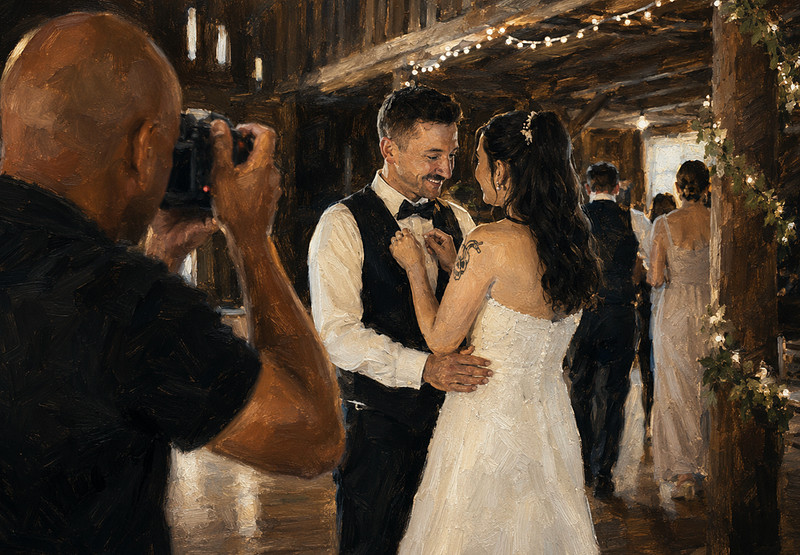
And occasionally, after spending most of the day surrounded by people, the couple gets 30 seconds when nobody needs anything from them.
Those situations cannot always be scheduled.
A photographer has to notice them.
For me, that is an important part of wedding photography. I want to photograph the events the couple planned, but I am also paying attention to what develops around them.
The Timeline Tells Me Where to Be. It Doesn't Tell Me Everything That Will Happen.
A good wedding photography timeline is useful.
If the ceremony begins at 3:00, I need to know that. If the bride is putting on her dress at 1:30, I should already be prepared. If family portraits immediately follow the ceremony, the necessary people need to be identified beforehand.
Planning prevents important photographs from being missed.
What I do not want is to become so dependent on the schedule that I stop looking around.
Imagine that the bride is putting on her dress.
There are obvious photographs to make: the dress itself, the fastening, the finished look.
But while that is happening, her mother may be watching quietly from the other side of the room. A bridesmaid may suddenly realize the wedding is actually about to happen. Someone might make a comment that changes the entire mood of the room.
If my attention is limited to checking "bride gets dressed" off a list, I may technically photograph the scheduled event while missing what made that particular version of it different.
The schedule gives me structure.
Observation fills in everything around it.
Getting Ready Is Usually About More Than Getting Ready
The beginning of a wedding day can tell you a lot about the people involved.
Some rooms are loud from the moment I arrive. Music is playing. People are moving everywhere. Someone is searching for a missing earring while another person is opening champagne.
Other rooms are surprisingly quiet.
The bride may be sitting with one or two people. The groom may be getting dressed almost entirely alone. Someone may step away from the group for a few minutes because they need a break.
I don't think those situations should be photographed identically.
There are photographs I know I need, but I also want enough time to understand what is actually happening in the room before I begin moving everyone around.
Sometimes the photograph is not the bride looking toward me after putting on her dress.
It is the person standing behind her trying not to cry.
Sometimes it is not the groom adjusting his cufflinks.
It is what happens immediately afterward when his father walks into the room.
If I am only watching the person who is supposed to be photographed, I am seeing only part of what is happening.
Some Reactions Are Better Photographed Before Anyone Realizes They Are Being Watched
People behave differently when a camera is directed toward them.
That isn't necessarily a problem. There are times when I want someone aware of the camera because I am intentionally creating a portrait.
But reactions operate differently.
A parent watching the ceremony does not need me to tell them how to look.
A friend laughing during a toast does not need posing.
The groom seeing the bride enter does not need direction.
Those photographs depend partly on anticipation.
During a ceremony, for example, the obvious subject may be the person speaking. But I may also be watching the other person listening.
During speeches, the person holding the microphone matters, but so does the couple's reaction. Then there are the parents, siblings, friends, and tables nearby.
Wedding photography becomes considerably more interesting when the photographer is asking:
What else is happening?
Sometimes the photograph I want is directly in front of me.
Sometimes it is behind me.
Transitions Are Still Part of the Wedding
There are periods on a wedding timeline that barely receive a label.
The ceremony ends and everyone walks outside.
The wedding party moves from one location to another.
The couple finishes portraits and heads toward cocktail hour.
Dinner ends and the room gradually shifts toward dancing.
Those transitions can look unimportant on paper.
Photographically, they can be excellent.
People stop thinking about what they are "supposed" to be doing.
The bride may pick up part of her dress and hurry across the street. The couple may laugh about something that happened during portraits. A bridesmaid helps someone with a shoe. The groom sees a relative he has not spoken to yet. Guests begin forming their own little groups.
Nobody scheduled those interactions.
That is precisely why they can feel different from the more formal portions of the day.
I still need to manage equipment, watch the time, and prepare for whatever is next.
But I don't automatically stop photographing because we're technically between events.
Couple Portraits Don't Always End When the Portrait Time Ends
Formal couple portraits require direction.
I may adjust where the couple stands, position hands, consider the light, change an angle, or move them somewhere because the background works better.
But some of my favorite opportunities with a couple happen when they think that part is temporarily over.
They may start talking while we're walking to another location.
One person fixes something on the other's clothing.
They laugh about how strange it feels to finally be married.
For a few seconds, they stop thinking about posing.
That does not mean I secretly photograph people every second of the day. There are times when couples need privacy and times when putting the camera down is appropriate.
The skill is recognizing the difference.
When an interaction naturally develops in front of me and it belongs to the wedding day, I want to be ready for it.
I Watch the People Around the Couple
A wedding is centered on two people, but they are rarely the only reason the day feels the way it does.
Parents, grandparents, siblings, children, friends, wedding-party members, and other guests create much of the activity surrounding them.
I pay attention to those relationships.
Not because every guest needs an equal number of photographs, and not because the photographer can know which interaction will eventually mean the most to someone.
The reason is simpler.
Those people are part of what happened.
A grandfather sitting quietly before the ceremony may only occupy one frame in a gallery. A sibling laughing during dinner may appear for half a second. A friend helping with the bride's dress may happen so quickly that nobody else notices.
Individually, these photographs might seem small.
Together, they give the gallery context that would be missing if every photograph centered on the scheduled event.
Children Are Especially Good at Ignoring the Wedding Timeline
Children do not care much about photography schedules.
That makes them interesting to photograph.
A flower girl might behave perfectly during portraits and then immediately start running through the reception. A ring bearer may spend the ceremony examining something on the floor. A child might dance harder than anyone else for 20 minutes and then fall asleep before dessert.
Those situations often say more about what it was like to actually be at the wedding than another photograph of the reception decor.
I don't need to manufacture them.
I just need to notice them.
The same applies to adults, although adults are usually better at remembering that a camera might be nearby.
Reception Photography Requires Looking Beyond the Dance Floor
Once dancing begins, it is easy for wedding photography to become centered almost entirely on whoever is moving the most.
The dance floor absolutely matters.
But the reception is happening around it too.
Someone may be sitting with a grandparent.
Two friends may be having an animated conversation at a table.
The couple may step away for a minute.
A parent may watch everyone else dance rather than joining them.
Someone may be laughing at something completely unrelated to whatever song is playing.
These are not substitutes for photographs of the first dance, speeches, cake cutting, or packed dance floor.
They make the coverage broader.
I want someone looking through the finished wedding gallery to understand that several things were happening at once.
Because that is usually what a wedding actually feels like.
Being Ready Matters Because These Moments Don't Repeat
A scheduled portrait gives the photographer some control.
If I need to adjust the bride's position, I can.
If someone's tie is crooked during a family photograph, I can fix it.
If I want to change my angle, I can usually create another frame.
Unplanned interactions work differently.
Someone reaches for someone's hand and then lets go.
A parent looks across the room.
A friend reacts to a joke.
The couple exchanges a look during the ceremony.
It happens once.
That is why wedding photography requires more than knowing camera settings or creating good portraits.
The photographer has to remain mentally engaged with the room.
Where are people looking?
Who is reacting?
What is about to happen?
If someone begins standing during a speech, why?
If a parent suddenly leaves their seat, where are they going?
Sometimes nothing develops.
Other times that small change tells me where the next photograph is going to happen.
This Is Also Why I Don't Want to Direct Every Second of the Day
Direction has an important place in wedding photography.
Family portraits need organization. Couple portraits usually benefit from guidance. Wedding parties often need someone to arrange the group efficiently.
But if the photographer controls every interaction, the photographs begin reflecting the photographer's instructions more than the wedding itself.
There has to be room where I stop directing and simply pay attention.
That balance changes throughout the day.
During portraits, I may be very involved.
During the ceremony, I am usually observing.
During the reception, I may briefly organize a requested group photograph and then return to watching what develops naturally.
The photographer should know when the situation needs help and when it does not.
The Small Photographs Help the Big Moments Make Sense
The first kiss will probably remain one of the obvious photographs in a wedding gallery.
So will the first dance.
So will portraits of the couple.
Those photographs establish major parts of the day.
But the smaller images around them often explain what those moments felt like.
The nervous expression before walking down the aisle makes the ceremony entrance different.
The reaction from a parent changes how the first dance reads.
The exhausted child asleep during the reception says something about how long the celebration has been going.
The couple finally sitting alone for a minute tells us something that another formal portrait cannot.
A wedding gallery does not need every photograph to compete for attention.
Some images provide context for the others.
I think that makes the complete set stronger.
Wedding Photography in Pittsburgh
When I photograph a wedding, I want to know the schedule.
I want to know when the important events are happening, which family combinations matter, how much time we have for portraits, and what needs to happen before the next part of the day begins.
Preparation matters.
But once the wedding starts, I also want to remain open to everything the schedule could not predict.
M4J Photography provides wedding and ceremony photography throughout Pittsburgh and the surrounding region, combining directed portraiture with attention to the interactions and unscheduled moments developing throughout the day.
The ceremony matters.
The portraits matter.
The first dance matters.
But the wedding is still happening while everyone is walking from one of those moments to the next.
Sometimes that is exactly where the photograph is.
