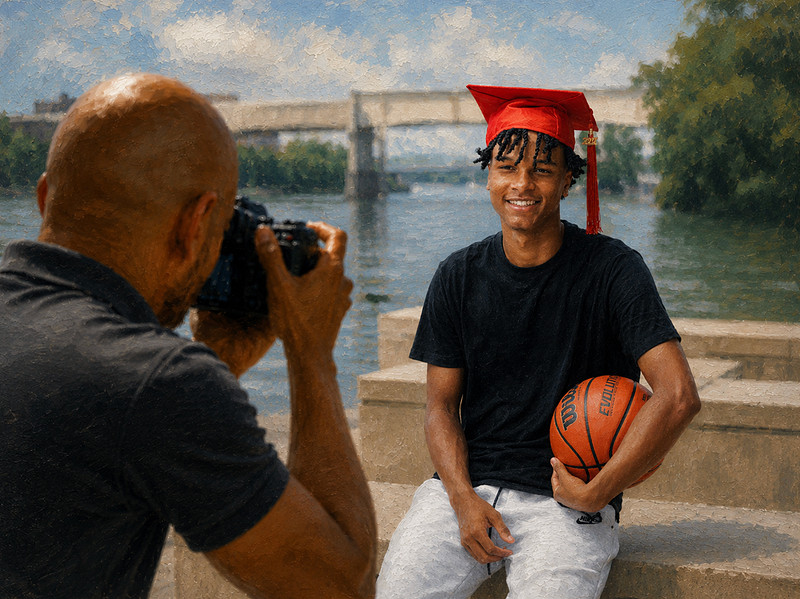

How Getting to Know Your Senior Can Make Their Photo Session More Comfortable
Parents are often more excited about senior pictures than the person actually being photographed.
That does not mean the senior dislikes the idea. They may simply be unsure what the session is going to feel like. Someone they have never met is going to point a camera at them, tell them where to stand, and photograph them while a parent may be watching from a few feet away.
For a teenager who already feels awkward in front of a camera, that can be enough to make the first few minutes uncomfortable.
One of the most useful things a photographer can do has very little to do with posing.
Get to know the senior.
Not through a questionnaire that tries to define their entire personality. Not by forcing conversation for the sake of getting a smile. It can be as simple as finding out what they actually enjoy, what they spend their time doing, what they are looking forward to, or what subject will get them talking.
For parents planning senior pictures in Pittsburgh, sharing some of that information with the photographer beforehand can make the session considerably easier.
A Senior Session May Not Have Been the Senior's Idea
This is something worth acknowledging.
A parent may have been thinking about high school senior photography for months. They researched Pittsburgh senior photographers, reserved the date, discussed locations, thought about outfits, and made sure everything was ready.
The senior may have participated in some of those decisions, or they may simply know that they are supposed to show up at a certain time.
Neither situation is unusual.
The photographer's first job is not to manufacture excitement. It is to make the senior feel as though they have some place in the process.
That is difficult to accomplish if the entire conversation sounds like this:
"Stand here."
"Turn your shoulder."
"Move your hand."
"Chin down."
"Smile."
Direction is necessary. Seniors should not be expected to arrive knowing how to pose. But if instructions are the only interaction taking place, the session can quickly feel like a performance.
Conversation changes that.
Parents Often Know Exactly Where the Conversation Should Start
Parents know things a photographer cannot possibly know from looking at a booking form.
Maybe their son could talk about cars for an hour.
Maybe their daughter has been drawing since elementary school and is applying to art programs.
Maybe the senior spends every available weekend fishing, knows every statistic about a particular sports team, plays guitar, loves horror movies, collects sneakers, cooks, lifts weights, games, dances, reads constantly, or has already decided exactly what they want to study after graduation.
None of those interests necessarily need to appear in the photographs.
That distinction matters.
Getting to know what a senior likes is different from turning every interest into a prop.
A student who loves basketball does not automatically need to hold a basketball. Someone interested in music does not necessarily need an instrument in every photograph. The value may simply be that the photographer now has a subject the senior genuinely wants to discuss.
Once a conversation feels normal, the camera often becomes less significant.
Tell the Photographer What Gets Your Senior Talking
There is a difference between useful background information and describing the senior in a way that unintentionally puts them into a box.
For example, telling a photographer:
"He's terrible at pictures and never smiles."
probably does not help much.
Neither does:
"She's really shy."
Those things may be true from the parent's perspective, but they tell the photographer more about what the senior supposedly struggles with than what might make communicating with them easier.
Something like this is considerably more useful:
"He takes a little while to warm up, but ask him about cars and he'll talk forever."
Or:
"She's really into fashion and has been excited about putting these outfits together herself."
Or:
"He's planning to study engineering and has been talking about college nonstop."
Now the photographer has somewhere to begin.
It does not need to be profound. The photographer is not trying to understand everything about the senior within an hour.
They just need enough information to stop treating the person in front of the camera like a stranger whose only job is to follow posing instructions.
Comfort Does Not Always Look Like a Big Smile
Parents sometimes watch a senior session and become concerned when their child is not smiling in every photograph.
But comfort and smiling are not the same thing.
Some people naturally smile constantly. Others have a more reserved expression that photographs extremely well. One senior may loosen up while talking. Another may become more comfortable once they start walking instead of standing still. Someone else may prefer looking away from the camera for certain portraits.
A good senior portrait gallery should have room for those differences.
The photographer can still encourage different expressions, but the objective should not be to produce the same large smile in every frame.
Sometimes the biggest change during a senior photo session is subtler.
The shoulders relax.
The hands stop looking carefully placed.
The senior stops waiting after every photograph to hear the next instruction.
They begin responding naturally to conversation.
They may even start suggesting an idea of their own.
That is often a better indication that someone has become comfortable than whether they smiled on command.
Parents Can Help Most by Giving the Photographer Some Room
Parents can be extremely useful during a senior photo session.
They can notice a twisted necklace, fix a collar, carry an additional outfit, keep track of belongings, or point out something the photographer may not know is important to the family.
But there can also be moments when stepping a little farther back helps.
A teenager may act differently when a parent is watching closely. That is not necessarily because there is anything wrong with the relationship. Most people become more self-conscious when someone who knows them well is observing them being photographed.
If the senior is already nervous, hearing instructions from both the photographer and a parent can make things harder.
"Smile."
"Stand up straight."
"Fix your hair."
"Don't do that face."
"Put your hand down."
Even well-intended comments can suddenly make the senior aware of every part of their body and expression.
Allowing the photographer to direct the session creates one clear source of instruction. It also gives the photographer and senior an opportunity to establish their own rhythm.
The parent does not need to disappear.
Sometimes moving a few steps away, sitting nearby, or simply allowing the conversation to happen without joining every exchange is enough.
The Photographer Should Learn When to Stop Talking Too
Getting to know a senior does not mean filling every second with conversation.
Some teenagers are naturally talkative. Others are not.
A photographer who keeps asking questions after receiving short answers can make the session feel more uncomfortable rather than less.
Part of photographing people well is noticing that difference.
Maybe the senior becomes animated when a particular subject comes up. Keep talking about it.
Maybe they would rather listen to music while being photographed. That can work too.
Maybe they respond better when the photographer gives clear instructions and then leaves a little silence between photographs.
The point is not that every senior needs to become friends with the photographer.
The point is that the photographer should pay enough attention to figure out what kind of interaction works.
What a Senior Likes Can Also Influence How They Are Photographed
Learning about the senior can affect more than conversation.
Someone interested in fashion may enjoy stronger poses and more deliberate compositions. An athlete may respond naturally to movement. A musician or artist may prefer photographs with a quieter feel. Someone who loves downtown Pittsburgh may be much more engaged in an urban senior session than they would be standing in a field simply because greenery is traditionally associated with senior pictures.
These are not rules.
They are clues.
The photographer can use those clues when deciding how much movement to incorporate, where to photograph the senior, whether to create something more editorial, and when to step away from a traditional pose.
This is also why senior photography should not feel identical from one student to the next.
The technical responsibilities remain the same. The photographer still needs to consider light, composition, posing, backgrounds, clothing, and expression.
The way the photographer gets there can change.
Give the Senior Something to Participate In
A senior photo session becomes much easier when the student feels that decisions are being made with them rather than around them.
That can be as simple as asking which background they prefer.
If two locations are nearby, ask which one they want to try first.
Show them a photograph from the back of the camera when it would be useful.
Ask whether they want something a little more formal or relaxed.
If they suggest an idea, consider it.
Not every suggestion will work photographically, but taking it seriously matters.
Parents still have priorities, too. They may want a traditional portrait for the house, a clear image for grandparents, or something appropriate for a graduation announcement.
Those photographs can coexist with images the senior chooses for themselves.
There does not need to be a competition between what parents want and what the student wants.
A Comfortable Session Usually Produces More Variety
When someone is uncomfortable, photographers tend to get the same expression repeatedly.
The person becomes cautious.
They stand where they are told, make the expression they think they are supposed to make, and wait.
Once they become more comfortable, the range of photographs often expands naturally.
You can create a quieter portrait and then something with movement. A direct expression can be followed by laughter from an actual conversation. A traditional composition can lead into something more editorial.
That variety is particularly useful for high school senior pictures because the photographs may ultimately be used differently by the senior and their family.
The objective is not to force someone's personality into the photographs.
It is to create an environment in which they no longer have to think quite so much about the fact that they are being photographed.
Planning a Senior Photo Session in Pittsburgh
Parents do not need to send the photographer a biography before a senior session.
A few useful details can be enough.
Tell the photographer what the senior enjoys, what usually gets them talking, whether they are excited or apprehensive about the session, and whether there is something about being photographed that makes them particularly uncomfortable.
Then allow the photographer to meet the senior for themselves.
M4J Photography provides high school senior photography throughout Pittsburgh and the surrounding areas. Sessions are planned around the individual senior, including location preferences, clothing, interests, comfort in front of the camera, and how the finished photographs will be used.
The photography still requires direction. But posing someone effectively becomes considerably easier once there is an actual conversation happening on the other side of the camera.
