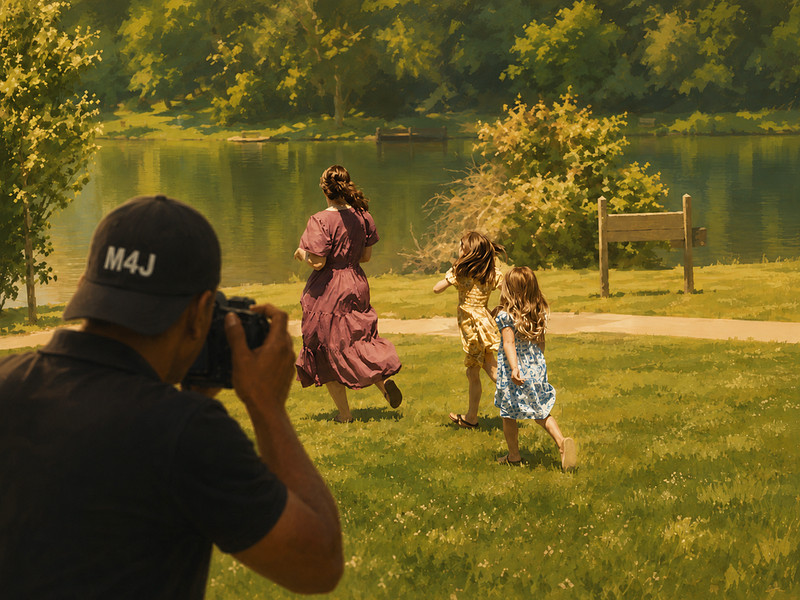

Family photographs do not need to rely on everyone standing in one place, looking at the camera, and repeating the same smile. A well-planned session can include the formal group portraits families expect while also using movement, conversation, play, and smaller groupings to create a broader set of images.
This approach works especially well with young children. Most children participate longer when they are given a clear activity instead of being asked to hold one position through repeated adjustments. Walking with a parent, playing with a sibling, exploring part of the location, or answering a question gives them something specific to do.
The session remains organized. The difference is that every photograph does not depend on controlling the exact position of each hand, shoulder, and expression.
Begin With the Family Portraits People Expect
Formal family portraits still have an important place in the session. These are often the photographs selected for frames, holiday cards, gifts, announcements, and multigenerational records.
I usually begin with the combinations that require the most attention while everyone is together and ready. That may include the full family, grandparents with grandchildren, each parent with the children, siblings together, and individual portraits of each child.
Completing those photographs early also gives younger children time to become familiar with the camera and the setting. Once the main arrangements are finished, the session can move into photographs that involve more activity and fewer instructions.
The formal portraits provide a clear record of who attended. The smaller groupings and interactions show how those people relate to one another.
Give Children Something Specific to Do
Instructions such as “smile,” “look here,” or “stand still” often lose their effectiveness when repeated. A child may cooperate for the first few photographs and then begin paying attention to everything else happening around them.
An activity gives the child a reason to participate.
Depending on the child’s age and personality, that might mean walking toward a parent, holding hands with a sibling, using a swing, playing a short game, telling someone a joke, looking for an object nearby, or showing a parent something they found.
These actions create changes in posture, expression, spacing, and body language without requiring the child to manufacture a reaction for the camera.
The activity should remain simple. Complicated games or too many instructions can pull attention away from the family and slow down the session. One clear action is usually enough.
Adjust the Direction to the Family
Families do not communicate or show affection in the same ways.
Some siblings stay close to one another. Others connect through jokes, competition, or constant movement. One child may participate immediately while another watches for several minutes before joining in. A younger child may remain close to one parent throughout the session.
The photography plan should respond to those differences.
If one parent consistently makes the children laugh, that person may help lead an activity. If a child needs more time, another grouping can be photographed first. If siblings become restless, the session can move to walking or play rather than repeating an arrangement that has already stopped working.
This requires the photographer to pay attention throughout the session instead of relying on the same sequence for every family.
Control the Setting Without Controlling Every Reaction
Interaction-based family photography still requires careful direction.
The photographer chooses the background, evaluates the light, places the family within the scene, and determines where movement can happen safely. Spacing also matters. Faces should remain visible, clothing should not block another person, and the group should stay within an area where the light remains consistent.
Once those decisions are made, the instruction can be simple.
A family may be placed on a path and asked to walk together. A parent may sit with a child in a section of open shade. Siblings may be positioned close enough to interact without being told exactly where to look every second.
The structure comes from the placement and preparation. The variation comes from what happens within that setup.
Photograph the Relationships Within the Family
A full-family portrait cannot show every relationship equally.
Separate photographs of parents with children, siblings together, grandparents with grandchildren, and parents as a couple create a fuller record of the family. They also change the pace of the session by giving people breaks from the full-group arrangement.
These combinations can reveal details that are difficult to see in a larger portrait. A child may speak differently with a grandparent than with a sibling. A parent may become more animated when photographed alone with one child. Older siblings may begin joking once the adults step away.
The photographer should know which combinations are important before the session begins, especially when several generations or households are participating. That prevents important pairings from being overlooked.
Choose a Location That Allows Movement
The location should support the type of session being planned.
Pittsburgh parks, gardens, neighborhoods, riverfront areas, urban spaces, and family homes can all work, but they provide different options. A park may allow children to walk, run, or use playground equipment. An urban location may offer architectural backgrounds but require closer supervision near traffic, stairs, or crowded walkways.
A family home can be useful when the children are very young, the weather is uncertain, or the property has a connection to the family. Indoor sessions also provide access to familiar furniture, toys, and routines, although the available space and window light need to be considered.
The best location is not necessarily the one with the most elaborate scenery. It is the one that gives the family enough room to participate comfortably while providing usable light and uncluttered backgrounds.
Parents Do Not Have to Manage Every Second
Parents often arrive prepared to keep the children smiling, facing forward, and following every instruction.
That can become another source of distraction.
A child looking away does not automatically ruin a photograph. A child moving toward a parent, adjusting clothing, reaching for a sibling, or reacting to something outside the frame may create a useful image. The photographer can decide whether the moment should continue or whether the group needs to be reset.
Parents usually help most by staying involved with their children rather than repeatedly correcting them. Talking, walking, playing, and responding to what the child is doing gives the photographer something to work with.
There will still be times when a child needs to return to a position or pause for a formal portrait. Those requests are easier to manage when they are not being made continuously throughout the session.
Keep Photographing Between Setups
The time between planned photographs can produce some of the most useful images in the gallery.
A parent may adjust a child’s jacket. Siblings may laugh after being released from a group portrait. A younger child may reach for a grandparent. The family may continue talking while walking to another section of the location.
These moments happen quickly and are easy to miss when the camera is lowered as soon as an instruction ends.
Remaining attentive during transitions adds gestures, reactions, and movement that do not appear in the formal arrangements. It also helps connect the separate parts of the session so the final gallery does not look like a collection of unrelated poses.
Build a Gallery With Clear Differences From Image to Image
A varied gallery should change in more than background or camera angle.
It should include full-group photographs, smaller combinations, individual portraits, wider environmental images, closer expressions, movement, and quieter interactions. The people, purpose, and composition should shift throughout the session.
Repeating the same arrangement with minor changes can produce a large number of photographs without adding much to the final selection.
The goal is to create images that serve different uses. A formal group portrait may be chosen for a frame. A close photograph of a parent and child may become a gift. A wider photograph may show the location, while a smaller interaction may preserve a gesture the family recognizes immediately.
Family Photography in Pittsburgh
M4J Photography plans family sessions around the people participating, the ages of the children, the location, and the photographs the family wants to receive.
Each session includes clear direction, formal group portraits, smaller family combinations, and activities selected according to how the family responds during the session.
Family photography is available throughout Pittsburgh and the surrounding areas. Message M4J Photography for availability and pricing.
